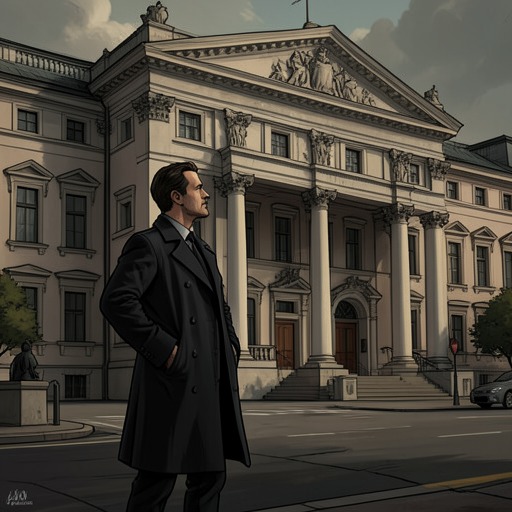
Vienna City Historical Museum
The World According to GarpThe Vienna City Historical Museum is the setting for a formative moment in T. S. Garp’s development as a writer: confronted with a preserved writer’s room and Franz Grillparzer’s fiction, he discovers that artistic confidence can begin with criticism. The museum’s small, ordinary room becomes less a monument to literary success than a test of how a writer makes a subject matter compelling.
Setting and Discovery
On a cold, snowy day in Vienna, Garp visited the museum after Jenny Fields told him it contained a writer’s room. She had seen the museum because it lay near the Schwindgasse apartment, but could not remember whose room it was. Her account—that the museum had preserved a writer’s furniture, and perhaps even the room’s walls and floor—made the idea intriguing to Garp, though he initially found the preservation of a writer’s private domestic space faintly indecorous.
The room belonged to Franz Grillparzer, an Austrian poet and dramatist whom Garp had never heard of. It looked ordinary and fragile: the bed seemed unusually small, almost like a child’s bed, and the writing table also appeared diminutive. Garp read the room as evidence against the image of an expansive literary figure; he even thought Jenny had a better place to write. The preserved space offered no grandeur to settle the question of what made its occupant a writer.
Grillparzer and Garp’s First Artistic Confidence
Garp followed the visit by reading Grillparzer’s long short story, “The Poor Fiddler.” He disliked it in German and disliked it again in an English translation he found at a secondhand bookstore on Habsburgergasse. He considered it sentimental and ineptly told, and contrasted it with Russian fiction: both could center on an indecisive failure, but Dostoevsky, in Garp’s view, could make such a character compelling where Grillparzer could not.
That contrast clarified a distinction more important to Garp than the story’s subject. Serious writing might concern familiar human difficulties, but subject matter alone could not account for the difference between a powerful work and a dull one. Garp concluded that the difference lay in intelligence, grace, and art. His confidence came before he had written anything substantial: judging Grillparzer as unworthy of the task let him imagine that he could do better. The episode is presented as a kind of competitive instinct, akin to spotting an opponent’s weakness in wrestling.
Garp even asked Jenny to read “The Poor Fiddler,” one of the few times he sought her literary judgment. She independently dismissed the story as simplistic and overly sentimental, and mother and son were delighted to agree. Their shared verdict turned a solitary act of literary judgment into a moment of fellowship.
A Place Recalled Through Garp’s Career
The museum’s importance extends beyond the visit. When Garp later published his Grillparzer story, an editor at a magazine that had rejected it eventually invited him to submit new work. Garp remembered the earlier rejection, preserved in a coffee-stained note that had been folded until it tore at the creases, and sent it back with a dry reply. The episode shows how the museum’s encounter with Grillparzer became part of a longer, sometimes combative engagement with literary judgment and recognition.
The reception of Garp’s novels also echoes the question first sharpened by the preserved room: whether a writer’s life or a work’s merits should govern its reading. Reviewers of his debut praised its historical research, originality, and scope, but often framed it through his identity as Jenny Fields’s son; one critic also noticed that he was still writing about bears. His publisher John Wolf recognized that readers were often more interested in Garp’s identity than in what he had written. Later, Garp’s second novel undersold the first and left him feeling, for the first time, that he had failed.
That tension became especially pronounced when The World According to Bensenhaver sold widely and attracted controversy. Its publisher’s jacket copy invoked Garp’s family identity and personal tragedy, although those facts were not, in Garp’s view, the measure of the novel’s art. A review helped establish the rumor that it was a feminist novel, and the book was later taught in colleges alongside Garp’s other works, Jenny’s autobiography, and a history of Steering School. The museum scene thus anticipates a recurring conflict in his career: the public’s appetite for the author’s life can overwhelm attention to the work itself.